
Introduction
Many SMEs struggle with accounting accuracy and inventory control as their business grows. Manual processes, Excel sheets, and disconnected systems create errors, delays, and financial losses.
Why SMEs Face Accounting & Inventory Problems
1. Manual Accounting Errors
Manual data entry and spreadsheets lead to:
- Calculation mistakes
- Duplicate entries
- Inaccurate financial reports
2. No Real-Time Visibility
Without an integrated system, SMEs lack:
- Real-time cash flow insights
- Accurate profit & loss reports
- Clear expense tracking
3. Poor Inventory Control
Common inventory issues include:
- Overstocking or stock shortages
- Sales and inventory not synced
- No centralized stock view
How Cloud ERP Solves These Issues
✔ Automated Accounting
Cloud ERP automates:
- Invoicing
- Journal entries
- Financial reporting
Result: Accurate, real-time accounts.
✔ Real-Time Inventory Management
Inventory updates automatically with each transaction.
- Low-stock alerts
- Better stock planning
- Reduced losses
✔ Integrated Business Operations
Sales, inventory, POS, and accounting work together in one system—no manual work.
Why SMEs Choose Cloud ERP
Cloud ERP offers:
- Lower cost
- Easy scalability
- Secure, anytime access
Conclusion
SMEs don’t fail due to lack of effort—they fail due to poor systems. Cloud ERP fixes accounting and inventory challenges by providing automation, accuracy, and control.
Cloud ERP is no longer optional—it’s essential for growing SMEs.
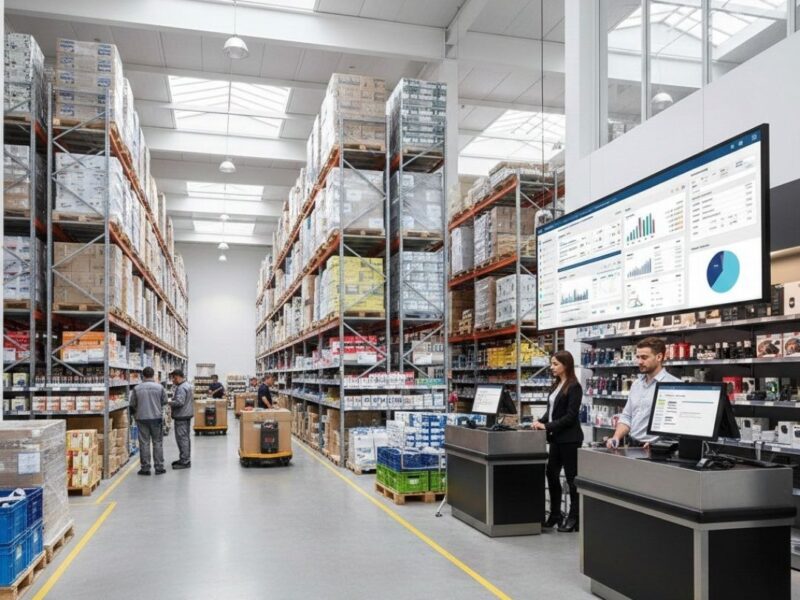
Running a distribution or retail business is challenging—managing stock, tracking sales, controlling expenses, handling suppliers, and making sure customers always get what they need. In today’s competitive market, businesses can’t rely on manual systems anymore.
This is where an ERP (Enterprise Resource Planning) system becomes a game-changer.
In this blog, we’ll explain how ERP helps distribution and retail businesses grow faster and operate smarter.
Why Distribution & Retail Businesses Need ERP
Distribution and retail companies deal with fast-moving products, changing demand, and razor-thin margins. An ERP system brings everything into one place so you can make quick and accurate decisions.
Key challenges ERP solves:
- Stock getting out of control
- Slow order processing
- Errors in billing and inventory
- Difficulty in tracking sales and customers
- Lack of real-time business insights
- Wastage and shrinkage
Top Benefits of ERP for Distribution & Retail
1. Real-Time Inventory Control
ERP helps you track:
- Stock levels
- Fast & slow-moving items
- Warehouse transfers
- Expiry and batch tracking
This reduces overstocking and stockouts.
2. Faster Order & Delivery Management
Manage the complete order lifecycle:
- Order booking
- Picking & packing
- Dispatch & delivery tracking
This improves customer satisfaction and reduces manual mistakes.
3. Integrated POS System
For retail stores:
- Fast billing
- Barcode scanning
- Automatic stock deduction
- Customer purchase history
Perfect for supermarkets, pharmacies, shoe stores, electronics shops, etc.
4. Better Supplier & Purchase Management
ERP helps you:
- Compare suppliers
- Control purchase costs
- Avoid unnecessary procurement
- Track pending POs and payments
5. Financial Control & Profit Visibility
Get instant visibility of:
- Daily sales
- Gross profit
- Expenses
- Credit & receivables
- Cash flow
This helps you grow sustainably.
6. Multi-Branch & Multi-Warehouse Support
If you have multiple branches or warehouses, ERP keeps everything synced in real time.
Who Should Use ERP in Distribution & Retail?
- FMCG distributors
- Wholesalers
- Supermarkets
- Pharmacy retailers
- Electronics & mobile shops
- Garments & footwear stores
- Car accessories shops
Conclusion
ERP is no longer optional—it’s essential for distribution and retail businesses that want to grow, reduce costs, and compete in today’s fast market. With real-time data, automated workflows, and complete visibility, ERP helps you run your business more efficiently and profitably.
Pakistan’s textile industry is a major contributor to the economy, responsible for nearly 60% of exports. Yet, many textile companies face challenges like production delays, manual tracking, and FBR compliance issues.
ERP (Enterprise Resource Planning) software solves these problems by integrating production, inventory, finance, and HR into a single system, providing real-time visibility and improving efficiency.
This blog explains how ERP can benefit textile companies in Pakistan, key modules, and how to choose the right system.
Challenges in Pakistan’s Textile Sector
- Rising raw material costs and production delays
- Inefficient manual record-keeping
- Limited real-time visibility for managers
- Compliance pressure from FBR e-invoicing
These challenges affect both SMEs and large manufacturers, making digital solutions essential.
Key Modules of a Textile ERP System
Production & Planning
Schedule orders, track progress, and optimize resources across spinning, weaving, dyeing, and stitching units.
Inventory & Warehouse Management
Monitor raw materials, chemicals, and finished goods with automated alerts to avoid stockouts or overstocking.
Accounting & Cost Control
Integrate financial management with production data for accurate cost tracking and profit analysis.
HR & Payroll
Simplify employee records, attendance, and payroll processes for large teams.
FBR E-Invoicing & Compliance
Automatically generate invoices compliant with FBR regulations, reducing errors and saving time.
Reporting & Analytics
Custom dashboards provide insights into production efficiency, sales, and profitability.
Benefits of ERP for Textile Companies
- Real-time visibility across departments
- Increased operational efficiency
- Cost savings through reduced wastage
- Faster, data-driven decisions
- Seamless FBR compliance
- Improved customer satisfaction
How to Choose the Right ERP
- Cloud-Based ERP: Access your system anytime, anywhere.
- FBR Integration: Automate compliance and invoicing.
- Customizable Modules: Fit ERP to spinning, weaving, dyeing, or garment production.
- Scalability: Grow without changing systems.
- Book a Demo: Test usability and features before buying.
Implementation Process
- Requirement Analysis: Identify key processes and needs.
- Configuration & Customization: Tailor modules for your operations.
- Data Migration: Move historical data safely.
- Training & Testing: Prepare staff and verify workflows.
- Go-Live & Support: Launch ERP with continuous assistance.
1. What is ERP software for textile companies?
ERP integrates production, inventory, accounting, and HR into one system for textile businesses.
2. How does ERP help with FBR compliance?
It automatically generates e-invoices and ensures all transactions follow FBR regulations.
3. Can ERP be customized for different textile processes?
Yes — spinning, weaving, dyeing, and garment production modules can be tailored to your operations.
4. What are the benefits of ERP for small textile businesses?
It streamlines operations, reduces costs, improves reporting, and ensures compliance.
5. How much does textile ERP software cost in Pakistan?
Costs vary by modules and users; cloud-based ERP plans are affordable for SMEs.
Conclusion
ERP software is essential for textile companies in Pakistan to boost efficiency, reduce costs, and stay FBR-compliant. By integrating production, inventory, finance, and HR into one platform, Eccountant ERP gives you real-time control, better decision-making, and a competitive edge.
Whether you manage a small mill or a large export-oriented factory, implementing ERP can transform your business operations. Book a free demo today and experience how Eccountant ERP can streamline your textile workflow.
See How Eccountant ERP Streamlines Textile Operations — Schedule a Consultation
Contact Us