Pharmaceutical and FMCG companies deal with complex operations every day. From purchasing raw materials and managing inventory to production, sales, distribution and accounting, every department needs accurate and timely information.
Managing these processes through spreadsheets or disconnected software can create inventory errors, delayed reporting, duplicate data entry and poor visibility across the business.
This is where ERP software for pharmaceutical and FMCG companies in Pakistan can make a significant difference.
A modern cloud ERP connects accounting, inventory, purchasing, sales, production, warehouse management, CRM, HR and reporting in one centralized system. For pharmaceutical businesses, it can help organize batch and expiry-related inventory information, while FMCG businesses can benefit from better stock, sales and distribution management.
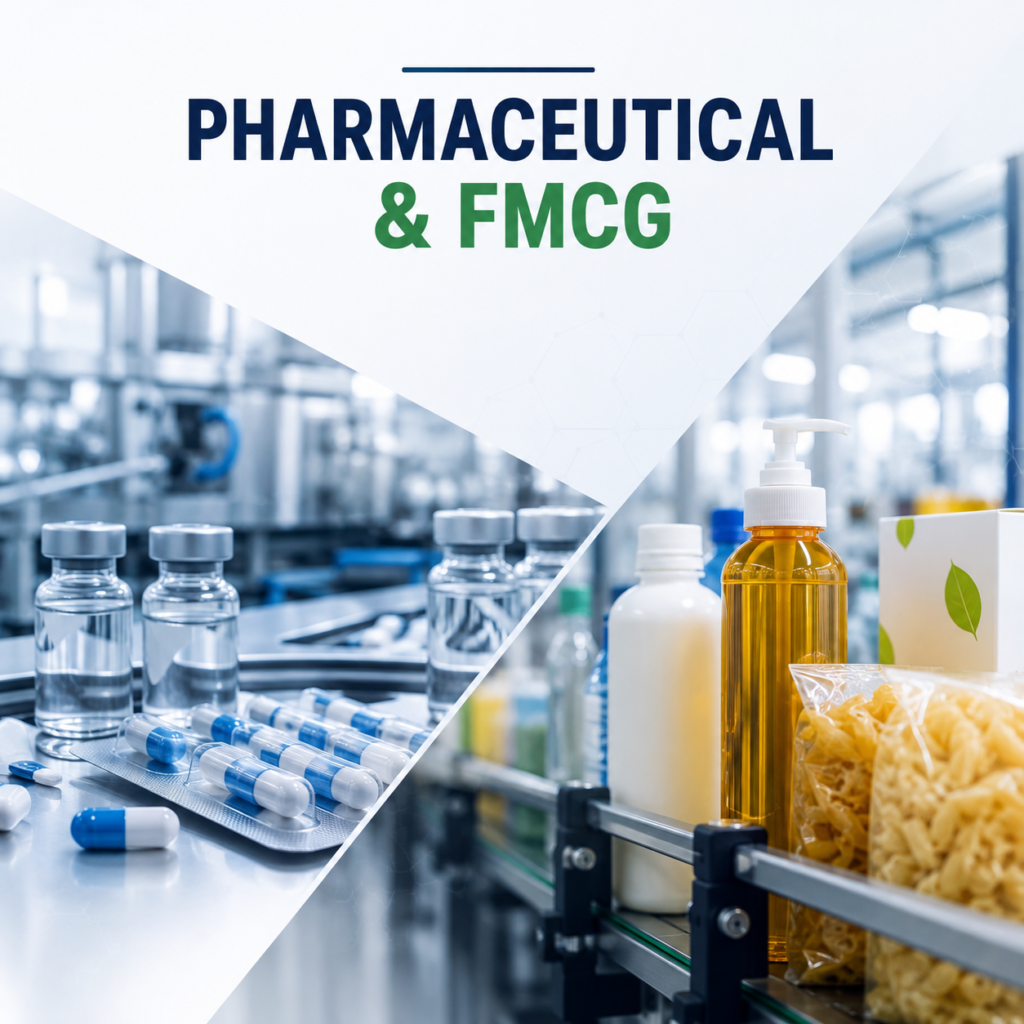
Why Do Pharmaceutical and FMCG Companies Need ERP Software?
Pharmaceutical and FMCG businesses operate with large inventories, multiple products, suppliers, customers and transactions.
A centralized ERP system can connect different departments and provide management with a clearer view of business operations.
Pharmaceutical businesses commonly need to manage:
- Raw materials
- Finished products
- Batch information
- Expiry dates
- Production
- Packaging materials
- Suppliers
- Inventory
- Sales and distribution
- Accounting
- Customer records
FMCG businesses commonly manage:
- Fast-moving products
- Multiple SKUs
- Warehouses
- Distributors
- Retailers
- Sales orders
- Purchase orders
- Stock transfers
- Customer accounts
- Sales teams
- Receivables and payables
Instead of maintaining separate records for each department, ERP software can bring these processes together.
Pharmaceutical ERP Software:
1. Inventory Management
Inventory is one of the most important areas for pharmaceutical businesses.
A pharmaceutical ERP system can provide centralized visibility into raw materials, packaging materials, work-in-progress inventory and finished goods.
Businesses can monitor:
- Available stock
- Warehouse inventory
- Stock movements
- Purchase receipts
- Sales dispatches
- Stock adjustments
- Inventory valuation
- Reorder requirements
Better inventory visibility can help businesses reduce unnecessary stock and improve purchasing decisions.
2. Batch and Expiry Tracking
Batch and expiry management is particularly important for pharmaceutical companies.
An ERP system can maintain relevant information against inventory batches, such as:
- Batch number
- Manufacturing date
- Expiry date
- Quantity
- Warehouse
- Purchase information
- Sales and dispatch information
This can make it easier for businesses to identify near-expiry inventory and improve stock rotation.
3. Production Management
Pharmaceutical manufacturers need to coordinate materials, production activities and finished products.
An ERP system can connect the production workflow with inventory and purchasing.
For example:
Purchase → Raw Materials → Production → Finished Goods → Inventory → Sales
This connected workflow can reduce repetitive data entry and provide better visibility into production operations.
4. Purchase and Supplier Management
Pharmaceutical companies often work with multiple suppliers for raw materials, packaging and other requirements.
ERP software can help manage:
- Purchase requisitions
- Purchase orders
- Supplier information
- Purchase invoices
- Supplier balances
- Material requirements
- Purchase history
- Outstanding payments
Management can use this information to make better purchasing decisions.
FMCG ERP Software for Inventory and Distribution
FMCG businesses operate in a high-volume environment where products can move quickly between suppliers, warehouses, distributors and retailers.
An FMCG ERP software can help businesses manage this complete flow from one platform.
1. FMCG Inventory Management
FMCG companies can have hundreds or thousands of SKUs.
An ERP system can help businesses monitor:
- Current stock
- Warehouse stock
- Fast-moving products
- Slow-moving products
- Stock transfers
- Low-stock items
- Purchase requirements
- Product movement
This can help reduce stock-outs and unnecessary overstocking.
2. Sales and Distribution Management
FMCG companies often sell through distributors, wholesalers, retailers and direct customers.
ERP software can connect the sales cycle:
Sales Order → Inventory Check → Dispatch → Invoice → Customer Ledger → Payment
This gives management greater visibility into sales and customer balances.
3. Multi-Warehouse Management
Growing FMCG businesses may operate warehouses in multiple cities or locations.
A centralized ERP can help management monitor inventory across different locations.
Businesses can manage:
- Warehouse stock
- Branch inventory
- Stock transfers
- Purchase receipts
- Sales dispatches
- Inventory valuation
This can make multi-location operations easier to monitor.
Accounting and ERP Integration
Managing accounting separately from sales and inventory can create reconciliation problems.
With an integrated ERP system, business transactions can flow directly into financial records.
For example:
Purchase → Inventory → Supplier Payable
and:
Sales → Inventory → Customer Receivable → Revenue
This integration can reduce manual reconciliation and provide management with more connected financial information.
Benefits of Cloud ERP for Pharmaceutical and FMCG Companies
Cloud ERP can provide businesses with centralized access to their operational data.
Depending on the system and implementation, businesses can benefit from:
Centralized Data
Departments can work with information stored in one connected system.
Better Inventory Visibility
Management can monitor stock across warehouses and locations.
Faster Reporting
Managers can access business reports without waiting for multiple departments to prepare separate spreadsheets.
Reduced Manual Work
Integrated workflows can reduce repetitive data entry.
Better Business Decisions
Management can use sales, inventory, purchasing and financial data to make informed decisions.
Scalability
A cloud ERP can support growing businesses as they add products, users, warehouses, branches and customers.
Eccountant Cloud ERP for Pharmaceutical and FMCG Businesses
Eccountant Cloud ERP is designed to bring important business operations together through an integrated ERP platform.
Businesses can manage:
- Accounting & Finance
- Sales
- Purchases
- Inventory
- Production
- CRM
- HR & Payroll
- Project Management
- Fixed Assets
- POS
- Analytics & Reporting
- Digital Invoicing
For pharmaceutical and FMCG businesses, connecting purchasing, inventory, sales, production and accounting can create a more structured workflow.
Instead of managing every department through separate spreadsheets and systems, businesses can centralize their operations within one ERP environment.
How to Choose the Best ERP Software for Pharmaceutical and FMCG Companies
Choosing an ERP is an important business decision. Companies should evaluate the software according to their actual operational requirements.
Before selecting an ERP, consider:
- Does it provide comprehensive inventory management?
- Can it support batch and expiry workflows where required?
- Does it support production and manufacturing?
- Can it manage multiple warehouses?
- Does it connect sales with inventory?
- Does it integrate accounting with business transactions?
- Does it provide management dashboards and reports?
- Is it cloud-based?
- Does it support local business and invoicing requirements?
- Does the provider offer implementation and technical support?
- Can the system be customized?
- Can it integrate with other business platforms?
The best ERP is not necessarily the one with the longest feature list. It is the one that fits the company’s processes and can support future growth.
Common Problems ERP Can Help Pharmaceutical and FMCG Businesses Address
Many growing businesses face similar operational challenges.
Problem 1: Inventory Errors
Separate spreadsheets can result in inconsistent stock records.
ERP approach: Centralize inventory transactions and stock records.
Problem 2: Poor Stock Visibility
Management may not know the exact stock available at different locations.
ERP approach: Use centralized warehouse and inventory reporting.
Problem 3: Manual Reporting
Employees may spend hours preparing reports from multiple spreadsheets.
ERP approach: Generate reports from centralized business data.
Problem 4: Disconnected Accounting
Sales and purchase information may not automatically reach the finance department.
ERP approach: Connect operational transactions with accounting.
Problem 5: Difficult Business Scaling
Adding new warehouses, products and users can make manual systems increasingly difficult to manage.
ERP approach: Use a scalable centralized ERP environment.
Final Thoughts
For pharmaceutical manufacturers, distributors and FMCG businesses, efficient management of inventory, purchasing, production, sales and accounting is essential for sustainable growth.
The right ERP software for pharmaceutical and FMCG companies in Pakistan can connect these business functions and provide management with better visibility across daily operations.
From inventory and batch information to production, sales, distribution, accounting and reporting, an integrated ERP system can help businesses replace disconnected processes with a more structured workflow.
For companies looking to move beyond spreadsheets and fragmented systems, cloud ERP can provide a scalable foundation for modern business management.
Frequently Asked Questions
What is ERP software for pharmaceutical companies?
Pharmaceutical ERP software is a business management platform that can connect inventory, purchasing, production, sales, accounting and reporting. Depending on the system, it can also support batch and expiry-related workflows.
What is FMCG ERP software?
FMCG ERP software helps manufacturers, distributors and wholesalers manage inventory, purchasing, sales, warehouses, customers, accounting and reporting through a centralized platform.
Why is batch tracking important in pharmaceutical ERP?
Batch tracking allows businesses to organize inventory according to specific batches and maintain relevant product information. This can improve inventory visibility and make stock management easier.
Can ERP software manage expiry dates?
ERP systems can support expiry-date management when expiry information is captured as part of the inventory or batch record. This can help businesses monitor products approaching expiry.
Can pharmaceutical companies use cloud ERP?
Yes. Cloud ERP can provide centralized access to business information and support collaboration between offices, warehouses and management teams.
Is ERP useful for FMCG distributors?
Yes. FMCG distributors can use ERP software for inventory, purchasing, sales orders, warehouse management, customer accounts, receivables and reporting.
Can ERP software manage multiple warehouses?
Many ERP systems support multiple warehouses and locations, allowing businesses to monitor stock movement and inventory across different locations.
How much does ERP software cost in Pakistan?
ERP pricing varies according to the number of users, modules, customization, implementation, integrations and business requirements. Companies should evaluate the overall cost and functionality before choosing a solution.
What should pharmaceutical companies check before buying ERP software?
They should evaluate inventory management, batch and expiry workflows, production, purchasing, sales, accounting, reporting, user permissions, integrations, customization and implementation support.
What is the difference between ERP and accounting software?
Accounting software primarily focuses on financial transactions, while ERP connects accounting with other business functions such as inventory, sales, purchasing, production, HR and operations.
The textile and apparel industry is one of the most complex manufacturing sectors, with operations involving raw materials, production planning, inventory, quality control, sales, purchasing, and financial management. As textile and apparel businesses grow, managing these processes through spreadsheets or disconnected software can become difficult.
A modern ERP software for textile and apparel industry helps businesses centralize operations, improve production efficiency, control inventory, and make better business decisions.
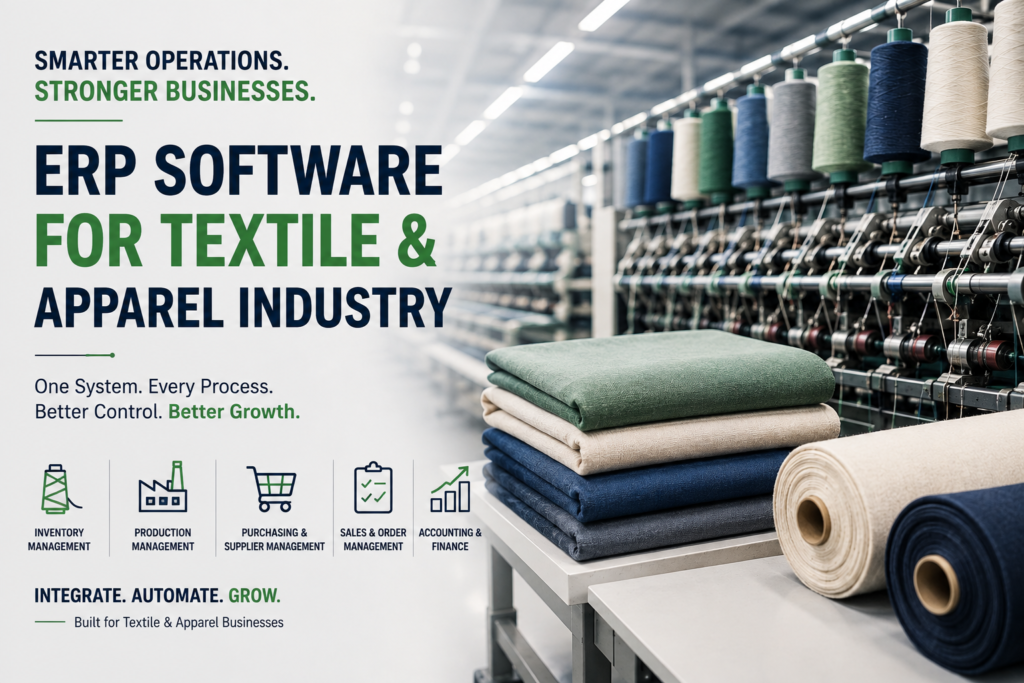
What Is ERP Software for Textile and Apparel Industry?
An ERP system for textile and apparel manufacturing connects different business functions through one centralized platform. It allows textile manufacturers, garment factories, apparel brands, wholesalers, and distributors to manage their operations from a single system.
From purchasing fabric and raw materials to production, inventory, sales, accounting, and reporting, an ERP for textile industry provides real-time visibility across the business.
Why Textile and Apparel Businesses Need ERP
Textile and apparel companies deal with multiple production stages, materials, product variations, suppliers, customers, and sales channels. Without an integrated system, businesses can face:
- Inventory management issues
- Production delays
- Manual data entry
- Poor demand forecasting
- Difficulty tracking raw materials
- Costing and profitability challenges
- Limited financial visibility
- Order management problems
- Communication gaps between departments
A textile ERP software brings these operations together and reduces dependency on manual processes.
Key Features of ERP for Textile Manufacturing
1. Textile Inventory Management
Inventory is one of the most important areas of textile manufacturing. An ERP system helps businesses track fabrics, yarn, dyes, accessories, finished goods, and other materials.
With centralized inventory management software for textile industry, businesses can monitor stock levels, purchases, consumption, transfers, and warehouse movements in real time.
2. Production Planning and Management
Effective production planning is essential for textile and garment manufacturers. ERP software can help manage production orders, material requirements, production stages, and work-in-progress.
A textile manufacturing ERP gives management better control over production schedules and helps identify bottlenecks before they affect delivery timelines.
3. Raw Material Management
Textile manufacturers use large quantities of raw materials such as yarn, fabric, chemicals, dyes, packaging materials, and accessories.
An ERP system helps track raw material purchases, consumption, availability, and warehouse stock, helping businesses maintain the right inventory levels.
4. Apparel and Garment Manufacturing Management
For apparel manufacturers, managing different styles, sizes, colors, designs, and product variations can be challenging.
An apparel ERP software can help businesses organize product information, production processes, inventory, sales orders, and customer requirements in one centralized system.
5. Purchasing and Supplier Management
ERP software allows textile companies to manage suppliers, purchase orders, quotations, receipts, and procurement activities.
Businesses can maintain supplier records and monitor purchasing costs, helping improve procurement decisions.
6. Sales and Order Management
Managing customer orders efficiently is critical for textile and apparel businesses. ERP software provides centralized visibility into sales orders, customer information, product availability, invoicing, and order status.
This helps businesses reduce errors and improve customer service.
7. Accounting and Financial Management
A complete ERP software for textile industry should connect operational activities with accounting.
Businesses can manage:
- Accounts receivable
- Accounts payable
- Expenses
- Invoices
- Payments
- General ledger
- Financial reports
- Profitability analysis
This gives management a clearer picture of business performance.
Benefits of ERP Software for Textile and Apparel Businesses
Implementing an ERP system can provide several advantages:
Better Inventory Control: Track raw materials, work-in-progress, and finished goods from one platform.
Improved Production Efficiency: Manage production planning and monitor manufacturing activities more effectively.
Reduced Manual Work: Automate repetitive administrative and financial processes.
Real-Time Business Data: Access updated information for faster decision-making.
Better Cost Control: Monitor purchasing, production, inventory, and operational costs.
Improved Order Management: Track customer orders from sales to fulfillment.
Scalable Operations: Support business growth without increasing operational complexity.
How to Choose the Best ERP for Textile and Apparel Industry
When selecting an ERP system, textile and apparel businesses should consider their specific operational requirements.
Look for an ERP solution that provides:
- Manufacturing and production management
- Textile inventory management
- Procurement and supplier management
- Sales and order management
- Accounting and finance
- HR and payroll
- Reporting and analytics
- Multi-location management
- Cloud access
- Customization options
- Integration capabilities
The right ERP software for textile manufacturing should be flexible enough to adapt to your production processes and business requirements.
Eccountant Cloud ERP for Textile and Apparel Businesses
Eccountant Cloud ERP helps businesses manage accounting, inventory, purchasing, sales, production, HR, payroll, CRM, projects, and reporting through one integrated platform.
For textile and apparel companies, a centralized ERP system can improve visibility across production, inventory, purchasing, sales, and finance while reducing dependence on disconnected systems.
Whether you are a textile manufacturer, garment manufacturer, apparel business, wholesaler, or growing manufacturing company, an integrated cloud ERP can help streamline your daily operations.
Final Thoughts
The textile and apparel industry requires accurate inventory management, efficient production planning, strong cost control, and reliable financial reporting. A modern ERP system for textile and apparel industry brings these functions together and gives businesses better control over their operations.
If your textile or apparel business is still relying on spreadsheets or multiple disconnected systems, moving to a centralized textile ERP software can help improve efficiency, visibility, and scalability.
What is ERP software for the textile industry?
It helps manage production, inventory, purchasing, sales, and accounting in one system.
Why do textile companies need ERP?
ERP improves inventory control, production planning, efficiency, and business visibility.
Can ERP manage textile inventory?
Yes, it can track yarn, fabric, raw materials, work-in-progress, and finished goods.
Is ERP useful for apparel businesses?
Yes, it helps manage production, orders, inventory, sales, and finances.
What is the best ERP for textile and apparel?
The best ERP is one that fits your production, inventory, accounting, and business requirements.
Introduction
Manufacturing businesses in Pakistan are under constant pressure to reduce operational costs, improve production efficiency, and maintain accurate inventory levels. Managing multiple departments through spreadsheets or disconnected systems often leads to delays, errors, and reduced productivity.
The best ERP software for manufacturing companies in Pakistan helps businesses automate their operations by integrating production, inventory, accounting, purchasing, sales, HR, and reporting into one centralized platform. A modern Manufacturing ERP enables companies to make faster decisions, reduce manual work, and improve overall business performance.
If you’re looking for the best ERP software for manufacturing companies in Pakistan, this guide explains everything you need to know and why Eccountant Cloud ERP is the preferred choice for manufacturers across Pakistan.
What is Manufacturing ERP Software?
Manufacturing ERP software is an Enterprise Resource Planning (ERP) solution designed specifically for manufacturing companies. It integrates production, inventory, procurement, finance, sales, HR, and reporting into a single cloud-based platform.
With Manufacturing ERP, businesses can:
- Track raw materials in real time
- Plan and monitor production
- Manage Bills of Materials (BOM)
- Control inventory levels
- Automate purchasing and supplier management
- Generate financial reports instantly
- Improve collaboration between departments
- Make faster business decisions with real-time dashboards
- Challenges Faced by Manufacturing Companies
Many manufacturing companies in Pakistan still rely on manual processes, spreadsheets, or disconnected software systems. This often creates operational challenges such as:
- Manual inventory management
- Production delays
- Stock shortages and overstocking
- Inefficient production planning
- Poor demand forecasting
- Lack of real-time financial reporting
- Communication gaps between departments
- Human errors caused by manual data entry
Implementing the best ERP software for manufacturing companies in Pakistan helps eliminate these challenges through automation and centralized data management.
Why Manufacturing Companies Need ERP Software in Pakistan
Pakistan’s manufacturing industry is becoming more competitive every year. Businesses need automation, real-time reporting, and complete operational visibility to stay ahead of the competition.
The best ERP software for manufacturing companies in Pakistan helps manufacturers:
- Improve production planning
- Reduce manufacturing costs
- Increase operational efficiency
- Monitor inventory in real time
- Improve financial management
- Reduce manual work
- Increase profitability
- Make data-driven decisions
- Features to Look for in Manufacturing ERP Software
When selecting ERP software for your manufacturing business, ensure it includes the following features.
Production Planning & Control
Manage production schedules, work orders, Bills of Materials (BOM), production tracking, and manufacturing workflows from one centralized dashboard.
Inventory Management
Track raw materials, work-in-progress (WIP), finished goods, warehouses, and stock movements in real time.
Purchase Management
Automate purchase requests, supplier management, procurement approvals, and purchase orders.
Sales & Order Management
Manage quotations, sales orders, deliveries, customer invoices, and sales performance efficiently.
Accounting & Finance
Automate accounting, financial reporting, budgeting, tax calculations, cash flow monitoring, and profit analysis.
Quality Control
Monitor product quality throughout the manufacturing process and reduce defects.
HR & Payroll
Manage employee attendance, payroll, leave, overtime, and performance from one platform.
Business Intelligence & Reporting
Generate real-time dashboards and reports that help management make informed business decisions.
How to Choose the Best ERP Software for Manufacturing Companies in Pakistan
Before investing in ERP software, evaluate the following factors:
- Cloud-based accessibility
- Production planning capabilities
- Inventory management features
- Accounting and finance integration
- Purchase and supplier management
- HR & Payroll module
- Business analytics and reporting
- Scalability for future growth
- Data security and role-based access
- Local support and implementation services
Choosing the right ERP solution ensures long-term business growth and operational efficiency.
Why Choose Eccountant Cloud ERP?
Eccountant Cloud ERP is one of the best ERP software solutions for manufacturing companies in Pakistan, helping businesses automate production, inventory, purchasing, accounting, HR, sales, and financial management from a single cloud-based platform.
- Key Benefits
- Cloud-based ERP accessible from anywhere
- Real-time inventory management
- Production planning and manufacturing control
- Purchase and supplier management
- Sales and CRM management
- Complete accounting and finance module
- HR & Payroll automation
- Multi-branch and warehouse management
- Role-based user permissions
- Powerful dashboards and business reports
- FBR Digital Invoicing Integration
Whether you’re operating a small manufacturing unit or a large industrial enterprise, Eccountant Cloud ERP grows with your business and improves operational efficiency.
Benefits of ERP for Manufacturing Companies
Implementing Manufacturing ERP provides several long-term business advantages.
- Increased production efficiency
- Reduced operational costs
- Better inventory control
- Faster production planning
- Improved order management
- Enhanced customer satisfaction
- Accurate financial reporting
- Better compliance and audit readiness
- Real-time business insights
- Higher profitability
Frequently Asked Questions (FAQs)
Which is the best ERP software for manufacturing companies in Pakistan?
Eccountant Cloud ERP is one of the leading ERP software solutions for manufacturing companies in Pakistan. It integrates production management, inventory control, accounting, HR, purchasing, sales, and reporting into one cloud-based platform.
Is ERP suitable for small manufacturing businesses?
Yes. Modern cloud ERP solutions are scalable and suitable for both small factories and large manufacturing enterprises.
Can ERP manage inventory and production together?
Absolutely. Manufacturing ERP integrates inventory management, production planning, procurement, accounting, and sales into a centralized system.
Does Eccountant ERP support FBR Digital Invoicing?
Yes. Eccountant Cloud ERP supports FBR Digital Invoicing integration, helping businesses comply with Pakistan’s taxation requirements.
What are the benefits of Manufacturing ERP?
Manufacturing ERP improves productivity, automates operations, reduces manual work, enhances inventory management, streamlines production, and provides real-time reporting for better decision-making.
Is Cloud ERP better than traditional ERP?
Yes. Cloud ERP provides secure remote access, automatic updates, lower infrastructure costs, improved scalability, and real-time collaboration across departments.
Final Thoughts
Selecting the best ERP software for manufacturing companies in Pakistan is a strategic investment that can transform your manufacturing operations. A modern cloud ERP enables businesses to automate production, manage inventory efficiently, improve financial control, and gain complete visibility across every department.
Whether you’re a small factory or a large manufacturing enterprise, Eccountant Cloud ERP delivers a scalable, secure, and feature-rich solution tailored to the evolving needs of Pakistan’s manufacturing industry.
Book your FREE Demo today and discover how Eccountant Cloud ERP can help transform your manufacturing business.

These days’ applications are the most extravagant source of business incentive to the organization. The primary objective of each business today is to augment the time their worker spends on center business activities, however fleeing from application services can influence the gainfulness and profitability of the organization.
Pakistani businesses are rapidly moving towards digitalization. With FBR e-invoicing, rising competition, and changing customer needs, ERP (Enterprise Resource Planning) software is becoming a must-have.
In today’s competitive business world, companies in Pakistan face rising costs, strict compliance rules, and higher customer expectations. To keep up, businesses need digital solutions. One of the most powerful…
In today’s fast-paced business world, companies need both speed and accuracy. Traditional paper invoices are time-consuming, prone to errors, and difficult to manage. The solution? Digital Invoices. Eccountant Cloud ERP…