
The textile and apparel industry is one of the most complex manufacturing sectors, with operations involving raw materials, production planning, inventory, quality control, sales, purchasing, and financial management. As textile and apparel businesses grow, managing these processes through spreadsheets or disconnected software can become difficult.
A modern ERP software for textile and apparel industry helps businesses centralize operations, improve production efficiency, control inventory, and make better business decisions.
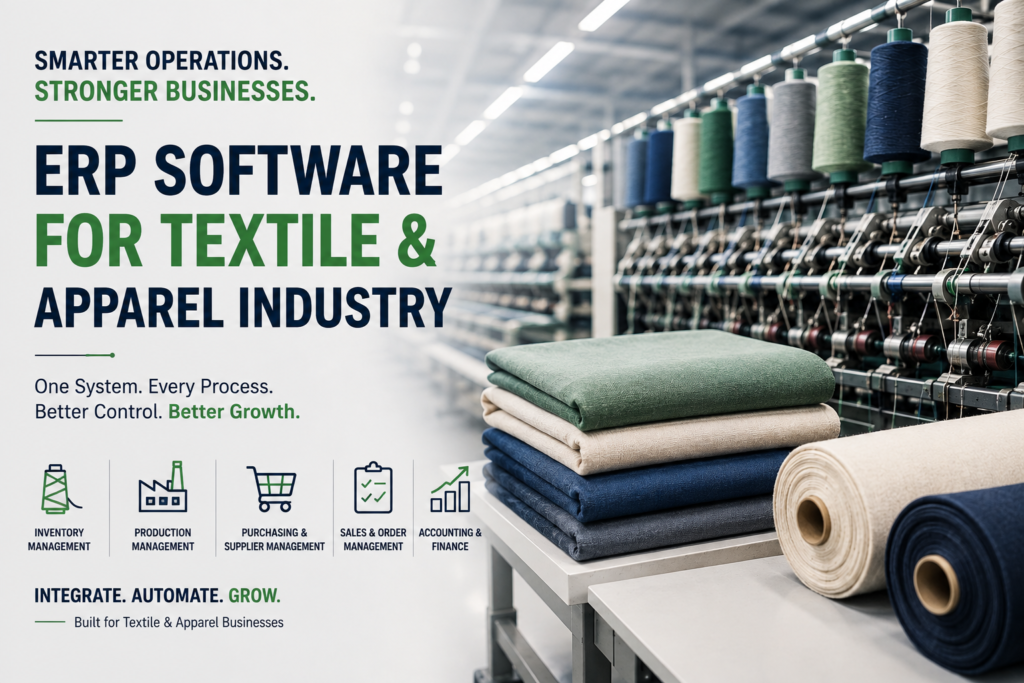
What Is ERP Software for Textile and Apparel Industry?
An ERP system for textile and apparel manufacturing connects different business functions through one centralized platform. It allows textile manufacturers, garment factories, apparel brands, wholesalers, and distributors to manage their operations from a single system.
From purchasing fabric and raw materials to production, inventory, sales, accounting, and reporting, an ERP for textile industry provides real-time visibility across the business.
Why Textile and Apparel Businesses Need ERP
Textile and apparel companies deal with multiple production stages, materials, product variations, suppliers, customers, and sales channels. Without an integrated system, businesses can face:
- Inventory management issues
- Production delays
- Manual data entry
- Poor demand forecasting
- Difficulty tracking raw materials
- Costing and profitability challenges
- Limited financial visibility
- Order management problems
- Communication gaps between departments
A textile ERP software brings these operations together and reduces dependency on manual processes.
Key Features of ERP for Textile Manufacturing
1. Textile Inventory Management
Inventory is one of the most important areas of textile manufacturing. An ERP system helps businesses track fabrics, yarn, dyes, accessories, finished goods, and other materials.
With centralized inventory management software for textile industry, businesses can monitor stock levels, purchases, consumption, transfers, and warehouse movements in real time.
2. Production Planning and Management
Effective production planning is essential for textile and garment manufacturers. ERP software can help manage production orders, material requirements, production stages, and work-in-progress.
A textile manufacturing ERP gives management better control over production schedules and helps identify bottlenecks before they affect delivery timelines.
3. Raw Material Management
Textile manufacturers use large quantities of raw materials such as yarn, fabric, chemicals, dyes, packaging materials, and accessories.
An ERP system helps track raw material purchases, consumption, availability, and warehouse stock, helping businesses maintain the right inventory levels.
4. Apparel and Garment Manufacturing Management
For apparel manufacturers, managing different styles, sizes, colors, designs, and product variations can be challenging.
An apparel ERP software can help businesses organize product information, production processes, inventory, sales orders, and customer requirements in one centralized system.
5. Purchasing and Supplier Management
ERP software allows textile companies to manage suppliers, purchase orders, quotations, receipts, and procurement activities.
Businesses can maintain supplier records and monitor purchasing costs, helping improve procurement decisions.
6. Sales and Order Management
Managing customer orders efficiently is critical for textile and apparel businesses. ERP software provides centralized visibility into sales orders, customer information, product availability, invoicing, and order status.
This helps businesses reduce errors and improve customer service.
7. Accounting and Financial Management
A complete ERP software for textile industry should connect operational activities with accounting.
Businesses can manage:
- Accounts receivable
- Accounts payable
- Expenses
- Invoices
- Payments
- General ledger
- Financial reports
- Profitability analysis
This gives management a clearer picture of business performance.
Benefits of ERP Software for Textile and Apparel Businesses
Implementing an ERP system can provide several advantages:
Better Inventory Control: Track raw materials, work-in-progress, and finished goods from one platform.
Improved Production Efficiency: Manage production planning and monitor manufacturing activities more effectively.
Reduced Manual Work: Automate repetitive administrative and financial processes.
Real-Time Business Data: Access updated information for faster decision-making.
Better Cost Control: Monitor purchasing, production, inventory, and operational costs.
Improved Order Management: Track customer orders from sales to fulfillment.
Scalable Operations: Support business growth without increasing operational complexity.
How to Choose the Best ERP for Textile and Apparel Industry
When selecting an ERP system, textile and apparel businesses should consider their specific operational requirements.
Look for an ERP solution that provides:
- Manufacturing and production management
- Textile inventory management
- Procurement and supplier management
- Sales and order management
- Accounting and finance
- HR and payroll
- Reporting and analytics
- Multi-location management
- Cloud access
- Customization options
- Integration capabilities
The right ERP software for textile manufacturing should be flexible enough to adapt to your production processes and business requirements.
Eccountant Cloud ERP for Textile and Apparel Businesses
Eccountant Cloud ERP helps businesses manage accounting, inventory, purchasing, sales, production, HR, payroll, CRM, projects, and reporting through one integrated platform.
For textile and apparel companies, a centralized ERP system can improve visibility across production, inventory, purchasing, sales, and finance while reducing dependence on disconnected systems.
Whether you are a textile manufacturer, garment manufacturer, apparel business, wholesaler, or growing manufacturing company, an integrated cloud ERP can help streamline your daily operations.
Final Thoughts
The textile and apparel industry requires accurate inventory management, efficient production planning, strong cost control, and reliable financial reporting. A modern ERP system for textile and apparel industry brings these functions together and gives businesses better control over their operations.
If your textile or apparel business is still relying on spreadsheets or multiple disconnected systems, moving to a centralized textile ERP software can help improve efficiency, visibility, and scalability.
What is ERP software for the textile industry?
It helps manage production, inventory, purchasing, sales, and accounting in one system.
Why do textile companies need ERP?
ERP improves inventory control, production planning, efficiency, and business visibility.
Can ERP manage textile inventory?
Yes, it can track yarn, fabric, raw materials, work-in-progress, and finished goods.
Is ERP useful for apparel businesses?
Yes, it helps manage production, orders, inventory, sales, and finances.
What is the best ERP for textile and apparel?
The best ERP is one that fits your production, inventory, accounting, and business requirements.